Wastewater Treatment — How a Plant Works, Stage by Stage
A working operator's reference to every stage of wastewater treatment, from headworks and clarifiers to activated sludge, disinfection, and solids handling.
From influent to outfall — what actually happens at a wastewater plant
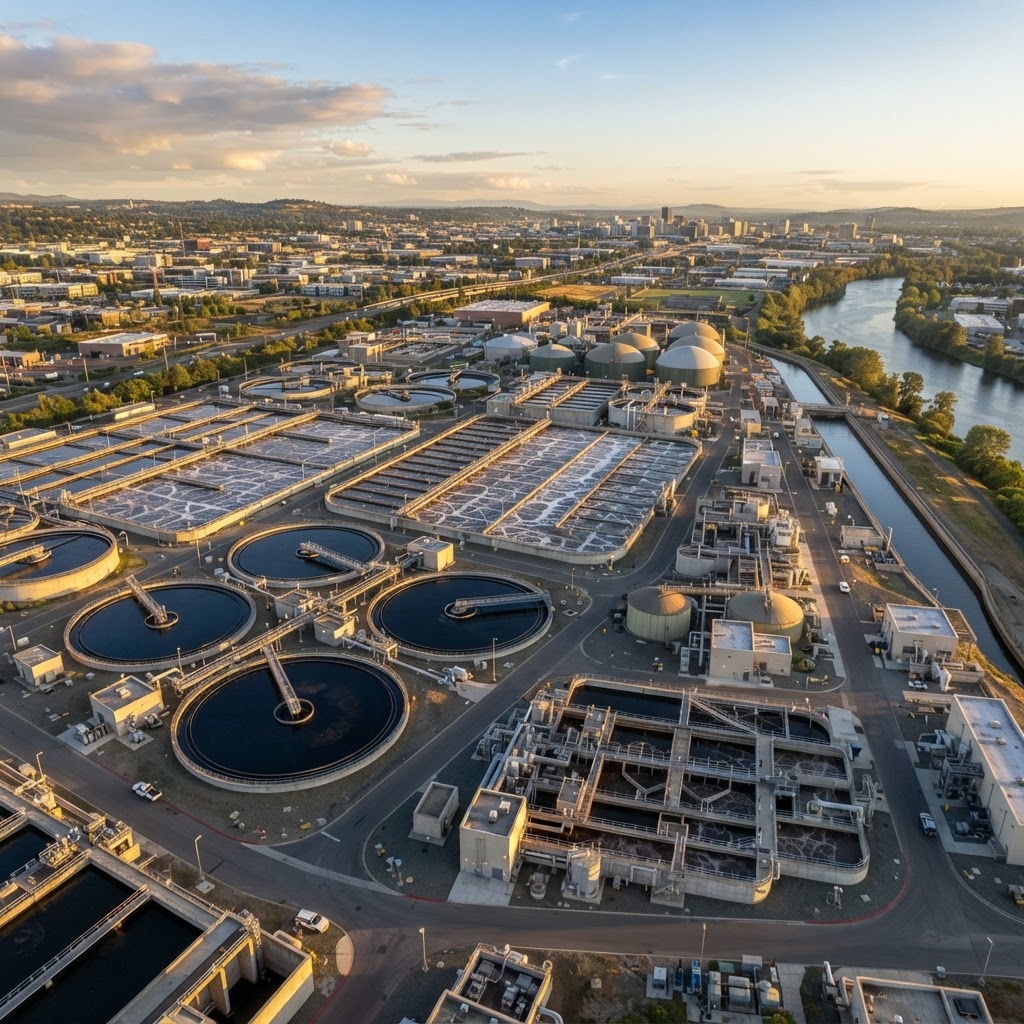
Wastewater treatment is the engineered removal of solids, organic matter, nutrients, and pathogens from sewage before discharge to a receiving stream. Every municipal plant follows the same core sequence: preliminary screening and grit removal, primary clarification, biological secondary treatment, secondary clarification, and disinfection — with a growing number of facilities adding tertiary filtration and nutrient removal to meet tighter NPDES limits.
For operators, the job is less about the pipes than about keeping the biology stable, the equipment running, and the effluent within permit, day after day. The reference below maps each stage to the process control, lab, equipment, and compliance knowledge you use on shift.
Preliminary & Primary
Bar screens, grit removal, and primary clarifiers that settle solids and remove floatables.
Read moreSecondary / Biological
Activated sludge, trickling filters, and RBCs that consume dissolved organics and produce settleable floc.
Read moreClarification & Return
Secondary clarifiers, RAS/WAS control, and the settling that keeps solids inventory balanced.
Read moreNutrient Removal
Nitrification, denitrification, and biological and chemical phosphorus removal for tight TN/TP limits.
Read moreDisinfection
UV banks and chlorine contact basins — dose, contact time, and the coliform limits that close the plant.
Read moreSolids Handling
Thickening, anaerobic digestion, dewatering, and biosolids management from feed sludge to cake.
Read morePillen Announces $38 Million Grant for Norfolk Wastewater Project
Nebraska Governor Jim Pillen announced a $38 million grant to support a $76 million upgrade to Norfolk's wastewater treatment system. The project is designed to modernize the facility and improve long-term operational capacity.
Source: Norfolk Daily News
Bedford, Ohio, Approved for $25.6M Wastewater Plant Upgrade
Bedford, Ohio, has received approval for a $25.6 million wastewater treatment plant upgrade project. The capital project is specifically aimed at increasing the facility's efficiency and significantly reducing wet-weather bypasses that can impact local water quality.
Source: Water & Wastes Digest
Gov. Pillen Highlights Major ONE RED Infrastructure Investment in Norfolk
Nebraska Governor Jim Pillen announced a $38 million grant for Norfolk to upgrade its wastewater treatment facility. The project focuses on anaerobic digestion and energy infrastructure to improve efficiency.
Source: Office of Governor Jim Pillen
North Carolina Reports $906 Million in Resilience Funding
As of July 2026, the North Carolina Department of Environmental Quality (DEQ) has awarded $906 million in state and federal funds to repair and upgrade water and wastewater infrastructure across the state, with a focus on flood resilience.
Source: NC.gov
Nebraska Receives Funding for Wastewater Digester Program
Nebraska Governor Jim Pillen and state officials highlighted a new $38 million grant for the City of Norfolk, supported by the state’s "ONE RED" initiative. The project will focus on the construction of anaerobic digestion and biogas infrastructure at a local wastewater facility.
Source: Nebraska.gov
EPA Awards $251M WIFIA Loan for California Water Reuse Project
On September 25, the EPA announced the approval of a $251 million WIFIA loan to support the "Pure Water Project" in California’s Las Virgenes-Conejo area. This initiative focuses on expanding advanced water treatment and reuse capabilities, benefiting approximately 105,000 residents.
Source: Water & Wastes Digest
Wastewater Technician
Veolia
Water/Wastewater Senior Project Manager
Veolia
Wastewater Technician
Veolia
Wastewater Treatment - Field Service Technician I
Veolia
Operator math for each stage of the wastewater plant.
Each calculator opens onto its own page with the formula, variable definitions, a worked example, and related operator math.
Detention Time
Calculate how long liquid theoretically stays in a tank or basin at a given flow rate.
BOD/TSS Removal Efficiency
Calculate the percent reduction between an influent and effluent concentration.
Chlorine CT Value
Calculate CT (concentration × time) for disinfection and check it against a required CT.
Chemical Feed Dosage
Find the pounds per day of a chemical needed for a given dose concentration and flow.
Frequently asked
What is wastewater treatment?+
Wastewater treatment is the process of removing solids, organic matter, nutrients, and pathogens from sewage and industrial effluent before discharging it to a receiving waterway. A typical plant uses preliminary screening, primary settling, a biological (secondary) step, clarification, disinfection, and solids handling to meet NPDES permit limits.
What are the main stages of wastewater treatment?+
Preliminary (bar screens, grit removal), primary (clarifiers that settle solids), secondary (biological treatment — activated sludge, trickling filters, or RBCs), secondary clarification, tertiary or advanced treatment (filtration, nutrient removal) when required, and disinfection (UV or chlorine) before discharge.
What is the difference between primary and secondary treatment?+
Primary treatment is physical: clarifiers gravity-settle suspended solids and skim floatables. Secondary treatment is biological: microorganisms consume dissolved organic matter, producing a biological floc that settles in secondary clarifiers. Secondary treatment reduces BOD and TSS far beyond what primary alone can achieve.
How is BOD removed in a wastewater treatment plant?+
Most BOD is removed in the biological step. Aerobic bacteria in the aeration basin consume organic carbon, converting it to CO2, water, and new cell mass. The biological floc then settles in the secondary clarifier and is either returned to the aeration tank (RAS) or wasted (WAS) to the digester.
The industry's most useful newsletter, straight from the plant floor.
One email. No fluff. New lessons, equipment breakdowns, and process control notes, delivered when there's something worth reading.